
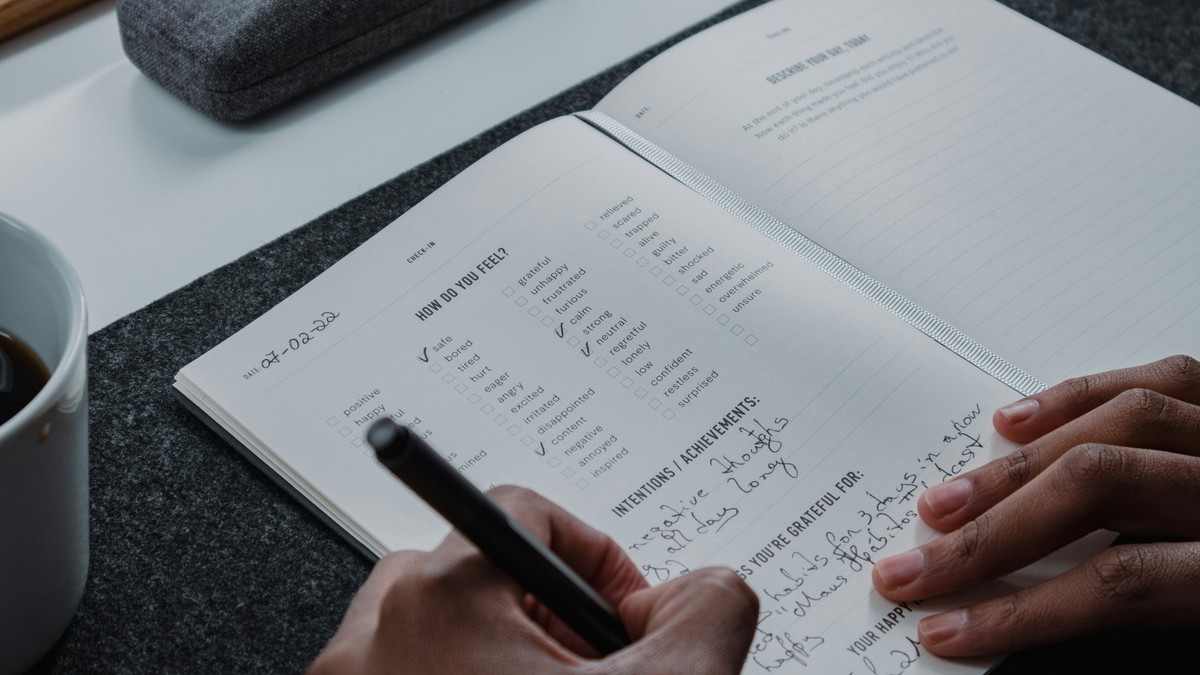
When stress is high, journaling can feel like one more thing to do. Many prompts also feel unrealistic: Write a love letter to yourself is not always what an overwhelmed mind needs. The most useful stress journaling is practical. It helps organise thoughts, reduce rumination, and create a small sense of control without requiring perfect insight or upbeat feelings.
How to set up a stress journal (so it gets used)
Friction is the enemy of consistency. Keep the setup simple and repeatable.
- Choose one format: a small notebook or a single notes app folder.
- Keep it short: 5-10 minutes is enough.
- Write messy: bullet points count. Complete sentences are optional.
- Pick a time cue: after lunch, after work, or right before bed.
- Use one page per entry: the end point prevents spiralling.
The goal is not beautiful pages. It is a clearer mind and a calmer nervous system. If writing feels hard, start with one line and permission to stop.
If privacy is a concern, keep entries short and factual, or use a password-protected notes app. Journaling is most effective when it feels safe.
Prompt set 1: Name the stress (reduce mental fog)
Stress feels bigger when it is vague. These prompts turn everything into specific, manageable parts.
- What is the stress about, in one sentence?
- What are the top three worries underneath it?
- What is fact, and what is prediction?
- What part is in control today, and what part is not?
- What decision is being avoided (or what choice feels impossible)?
End this section with one clarity line: The core issue is ______. Naming the core issue reduces the brain’s tendency to keep searching for the real problem.
Prompt set 2: Unload the loop (stop replaying the same thoughts)
Rumination often repeats because the brain wants an answer. Writing gives the brain a place to store the loop so it can stop rehearsing it.
- What thought keeps repeating?
- What is the worst-case scenario the mind is rehearsing?
- If that happened, what would the first practical step be?
- What would a good enough outcome look like?
- What is being assumed about other people’s reactions?
This is not about being optimistic. It is about shifting from dread to planning. When the mind says “This is unbearable”, translate it into specifics: This would be difficult because ______.
Prompt set 3: Shrink the task (create one next action)
Stress increases when tasks feel too large or undefined. This set turns a heavy situation into a next action that can be completed.
- What is one thing that would make this 10% easier?
- What is the smallest next step (under 10 minutes)?
- Who could help, and what exactly would be asked?
- What can be postponed without real consequences?
- What would be the next step if motivation stays low?
Finish with a single line: Next action: ______ (when: ______). If the next action is unclear, the journal entry is not finished; keep shrinking until it is obvious.
Prompt set 4: Regulate the body (stress is physical)
Writing can be paired with a quick body check. This helps notice when stress is being held as tension and offers a direct way to reduce it.
- Where is stress felt in the body (jaw, chest, stomach, shoulders)?
- What does the body need right now: water, food, movement, rest?
- What would be soothing for 5 minutes?
- What boundary would protect energy today?
- What is one too much input to reduce (news, messaging, extra commitments)?
Consider adding one calming action immediately after journaling, such as a short walk, a warm shower, or one minute of slow breathing. A journal is more effective when it leads to one small regulating action.
Prompt set 5: Kind but not cheesy self-talk
Supportive self-talk does not need to be sentimental. It needs to be accurate and stabilising.
- What would be said to a friend in the same situation?
- What is a realistic reminder (not a slogan) that helps?
- What has been handled before that proves capability?
- What is one strength being used right now (even if it feels small)?
- What would steady look like for the next hour?
Try a grounded closing line: “This is hard, and it is being handled step by step.” If emotions are intense, add permission: “It is OK to be upset and still take the next step.”
If journaling increases anxiety (for example, by intensifying rumination), switch formats: write only facts and next actions, or use a timer and stop at five minutes. A journal should reduce load, not deepen the spiral.
Next steps (a 7-day journaling plan)
For the next seven days, journal for 5-10 minutes using one prompt set per day. Keep the entry short and end with one next action or one boundary. If the mind tries to write a novel, switch to bullet points and stop when the action is identified.
After a week, keep the two prompt sets that create the most relief and make them a default response to stressful days. A practical journal is not a diary; it is a tool for clarity, containment, and calmer decisions.